
Nature Conservation is Our Responsibility: Experts Deliver Message of Sustainable Lifestyle at BBAU
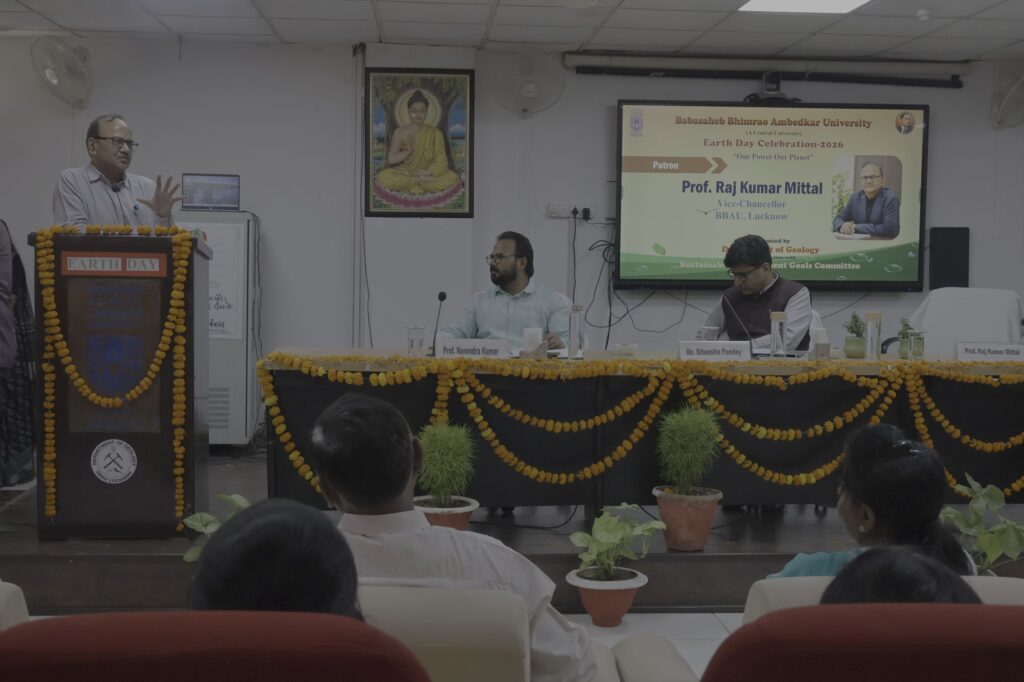
On the occasion of “World Earth Day”, A program was organized on 22nd April under the joint aegis of the Department of Geology, BBAU, and the Sustainable Development Goals Committee at Babasaheb Bhimrao Ambedkar University. This year’s official theme of World Earth Day 2026, “Our Power, Our Planet,” was kept in focus while organizing the event. The program was chaired by the Vice-Chancellor of the University, Prof. Raj Kumar Mittal. The Chief Guest for the occasion was the District Forest Officer of Awadh Province, Lucknow, Mr. Shitanshu Pandey. Apart from this, Guest of Honour and Professor Emeritus from Panjab University, Prof. Ashok Sahni, Program Convenor and Head of the Department of Geology, Prof. Narendra Kumar and Chairperson of the Sustainable Development Goals Committee, Prof. Naveen Kumar Arora were present on the dais. The program commenced with the ceremonial lighting of the lamp and floral tribute to the portrait of Babasaheb. Following the University anthem, the organizing committee welcomed the dignitaries by presenting them with saplings. At the beginning, the Program Coordinator, Prof. Narendra Kumar, welcomed all the attendees. Prof. Naveen Kumar Arora then introduced the objectives and outline of the program.
In his address, Vice-Chancellor Prof. Raj Kumar Mittal emphasized that in Indian culture, the principle “Dharmo Rakshati Rakshitah” holds great importance, meaning that one who protects righteousness is himself protected. He explained that nature is an integral part of our dharma, and therefore, protecting it is our foremost duty. He highlighted that the excessive and uncontrolled use of technology and natural resources is disturbing the Earth’s balance. Hence, resources must be used in a balanced and responsible manner to ensure a safe and clean environment for future generations. He also stressed the importance of effective management in conserving natural resources and the need to adopt principles like “Reduce, Reuse, and Recycle.” He further added that natural resources take years, sometimes centuries, to form, making their conservation essential. Encouraging students, he suggested simple actions such as planting trees, conserving water, composting organic waste, and maintaining cleanliness to contribute towards sustainable development.
Chief guest and District Forest Officer Mr. Shitanshu Pandey stated that the Vedas mention “Mata Bhumih Putro’ham Prithivyah,” meaning the Earth is our mother and we are her children. He urged that this feelings should be reflected not only in words but also in actions. He emphasized that sustainability is not just a practice but a lifestyle that must be incorporated into daily life. He highlighted that small individual efforts can lead to significant changes if everyone takes responsibility. He also explained that forests are not merely collections of trees but function as vital carbon sinks, absorbing carbon dioxide and mitigating climate change. He remarked, “There is no Plan B, because there is no Planet B,” and appealed especially to the youth to stay aware, use resources wisely, and actively contribute to building a sustainable future.
Guest of honour and Professor Emeritus from Panjab University, Prof. Ashok Sahni, spoke on topics such as “Earth and Evolution of Sight” and “Life Without Sight.” He explained that the development of life on Earth is the result of a long and complex process. Early organisms lacked vision, but over time, environmental needs and adaptation led to the development of sight, enabling organisms to better understand their surroundings and survive. He also highlighted that the development of locomotion and vision occurred simultaneously in many species, enhancing their efficiency and survival capabilities. According to him, understanding the complexity and balance of life on Earth is crucial for its conservation.
Program Convenor and Head of the Department of Geology, Prof. Narendra Kumar, stated that the Earth is a living entity undergoing continuous change and balance. He emphasized that environmental sustainability is key to maintaining this vitality. For this, a comprehensive approach is required at three levels – policy, institutional, and individual. Strong eco-friendly policies and strict implementation are necessary at the policy level, while institutions must promote awareness and balanced resource usage. At the individual level, people must adopt simple practices such as saving energy and water, maintaining cleanliness, and behaving responsibly towards nature.
Chairperson of the Sustainable Development Goals Committee, Prof. Naveen Kumar Arora, remarked that every day should be treated as Earth Day, and we must act accordingly. He stressed that knowledge limited to data and books becomes meaningful only when implemented at the grassroots level. Real change in environmental conservation is possible only through active participation of all sections of society. He highlighted the importance of community and civic engagement, stating that collective efforts can bring large-scale positive change. He urged people to become responsible citizens and contribute to sustainable development through small but meaningful actions. He also noted that if every individual fulfills their responsibilities, environmental conservation can turn into a mass movement.
At the end, the organizing committee presented mementos to the dignitaries as a token of gratitude, followed by a vote of thanks delivered by Dr. Chimpari Srajani.
On this occasion, a special lecture session was organized for students. Speakers included Prof. Dhruv Sen Singh, Head of the Department of Geology at Lucknow University, retired IFS officer Dr. Umashankar Singh and Principal Scientist at CSIR-CIMAP, Dr. Sanjay Kumar. A panel discussion was also conducted.
During the valedictory session, winners of various competitions held on April 21, on the eve of World Earth Day such as poster making, rangoli, speech, reel challenge, poetry recitation, and quiz were awarded.
The event witnessed the presence of deans, heads of departments, faculty members, non-teaching staff, research scholars, participants, and students from various faculties.













 https://www.youtube.com/watch?si=RtToJsBhYBatUrym&v=mOuYNSdhjHA&feature=youtu.be