
Emphasis on making Indian languages a strong medium of knowledge, research and education; workshop concludes at BBAU
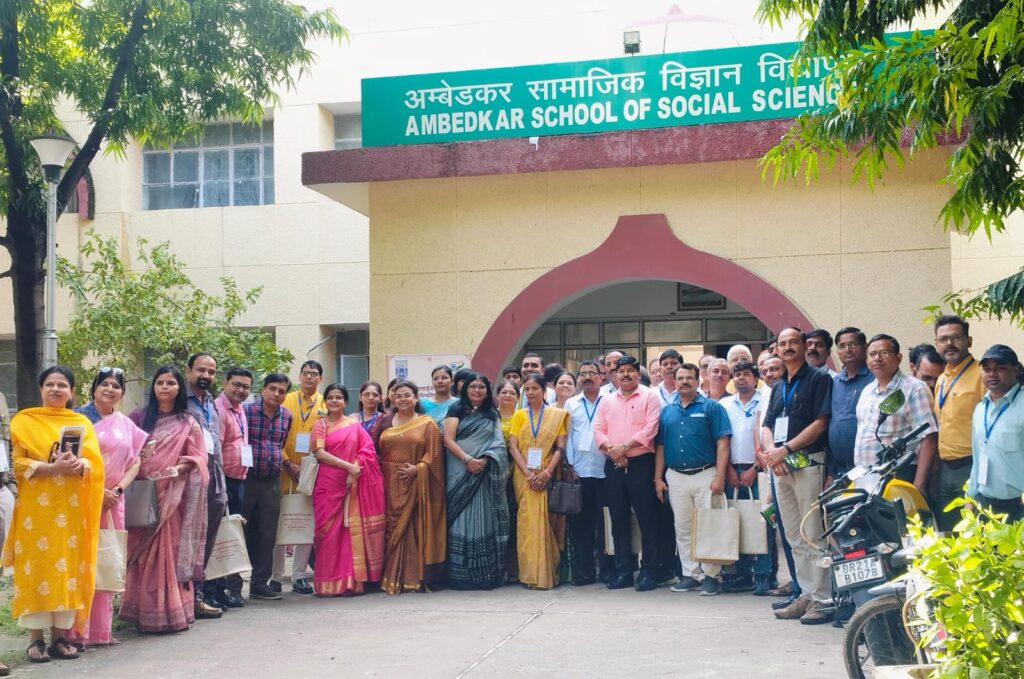
Lucknow: A two-day workshop on “State-Level Implementation of the Bhartiya Bhasha Pustak Yojna”, jointly organized by Babasaheb Bhimrao Ambedkar University (BBAU) and the Indian Language Committee, Ministry of Education, Government of India, concluded on September 8 at Babasaheb Bhimrao Ambedkar University. The programme was organized under the guidance and patronage of the Hon’ble Vice-Chancellor of the University, Prof. Raj Kumar Mittal. The valedictory session was attended by Prof. Narendra Narayan from Kashi Vidyapeeth, Varanasi, Prof. Sushma Pandey from Deendayal Upadhyaya University, Gorakhpur, Dr. Chandan Shrivastava, Academic Coordinator, Bhartiya Bhasha Samiti, Prof. Shailesh Mishra from Sampurnanand Sanskrit University, Varanasi, Dr. Ajay Mishra, Principal, Jawaharlal Nehru Memorial P.G. College, Maharajganj and Programme Coordinator Dr. Baljeet Kumar Srivastava. At the outset, Prof. Udayan Mishra welcomed all the guests and participants and apprised them of the objectives and outline of the programme.
In his address, Prof. Narendra Narayan of Kashi Vidyapeeth, Varanasi, quoted the famous lines of Bharatendu Harishchandra, “Nij bhasha unnati ahai, sab unnati ko mool. Bin nij bhasha-gyan ke, mitat na hiy ko shool,” and highlighted the significance of language. He stated that language plays a vital role in shaping the cultural identity, knowledge development and social consciousness of any nation. Prof. Narayan discussed the efforts being undertaken in various countries for the promotion, propagation, teaching and learning of Hindi and highlighted its growing global acceptance. He also referred to eminent literary figures such as Maithilisharan Gupt, Ramdhari Singh ‘Dinkar’, Bharatendu Harishchandra and Munshi Premchand, who enriched Hindi literature through their works while also strengthening social awareness, national consciousness and human values. He emphasized that Hindi should not be confined merely to literature and communication but should also be developed as a strong language of education, research and knowledge creation.
Dr. Chandan Shrivastava, Academic Coordinator, Indian Language Committee, said that the primary objective of the workshop organized for the state-level implementation of the Bhartiya Bhasha Pustak Yojna is to reconnect with Indian history, culture and the rich Indian knowledge tradition and undertake serious work in these areas. He stated that India’s rich knowledge tradition encompasses extensive knowledge in education, science, medicine, mathematics, philosophy, art and values of life. There is a need to make this knowledge accessible to the younger generation through Indian languages and develop it in accordance with contemporary requirements. Dr. Shrivastava further stated that the creation and widespread dissemination of quality books in Indian languages is essential not only for the preservation and promotion of these languages but also for connecting students with their roots, history and cultural heritage.
Prof. Sushma Pandey of Deendayal Upadhyaya University, Gorakhpur, expressed the view that a country can achieve genuine and comprehensive progress through its own language, as language serves as a powerful medium of connecting with the common people and taking knowledge to the last person in society. She stated that India has a long and rich tradition of the Guru-Shishya relationship and that the country’s Vedic education, yoga and knowledge traditions are recognized across the world. Referring to the provisions and efforts related to language and education from the National Education Policy of 1986 to the National Education Policy-2020, she emphasized that giving Indian languages their rightful place in education and knowledge discourse is the need of the hour. She further stated that it is our responsibility to Indianize the education system and transmit the country’s rich knowledge traditions, languages and cultural values to the younger generation through education.
Prof. Shailesh Mishra of Sampurnanand Sanskrit University, Varanasi, stated that digitalization can play an important role in promoting Indian languages on a wider scale and in effectively connecting them with the younger generation. He said that in the present digital era, knowledge available in Indian languages can be made accessible to a larger audience through e-books, digital libraries, online learning material, audio-visual content and various digital platforms. He also emphasized the need to create, translate and disseminate quality and contemporary content in Indian languages through technology so that students and young people can acquire knowledge in their own languages and develop a stronger connection with them.
Dr. Ajay Mishra, Principal of Jawaharlal Nehru Memorial P.G. College, Maharajganj, in his address highlighted the changes that have taken place in the nature of research from earlier years to the present time. He stated that the primary objective of research should be to understand the real problems of society, identify their causes and suggest practical solutions. Emphasizing the need to reconnect research with society and public concerns, he said that research can truly be considered meaningful only when its benefits reach the last person in society. He also stressed the need to promote research in the Hindi language and stated that Hindi should not be restricted merely to communication but should be developed as a strong language of knowledge, research and academic discourse.
A special session on “Bhartiya Bhasha Pustak Yojna: An Introduction” was also organized during the programme. The session witnessed extensive discussions on various aspects related to promoting the creation, publication and dissemination of high-quality books in Indian languages. Participants shared their views on the formats and procedures related to the implementation of the scheme at the state level. Through group activities, the participants got an opportunity to deliberate on the possibilities and challenges associated with the implementation of the scheme and present useful and practical suggestions. The session emphasized strengthening collective and coordinated efforts towards promoting quality book publishing in Indian languages and ensuring the effective implementation of the scheme at the state level.
Teachers and participants from various academic institutions, faculty members of BBAU, non-teaching officials and other members were present throughout the programme.







 ---------------------------------------------------------------------------------------
 ----------------------------------------------------------------------------------------
 ---------------------------------------------------------------------------------------------
------
---------------------------------------------------------------------------------------------
---------------------------------------------------------------------------------------------------