
BBAU Workshop Focuses on Transforming Research into Prototypes and Practical Technological Solutions
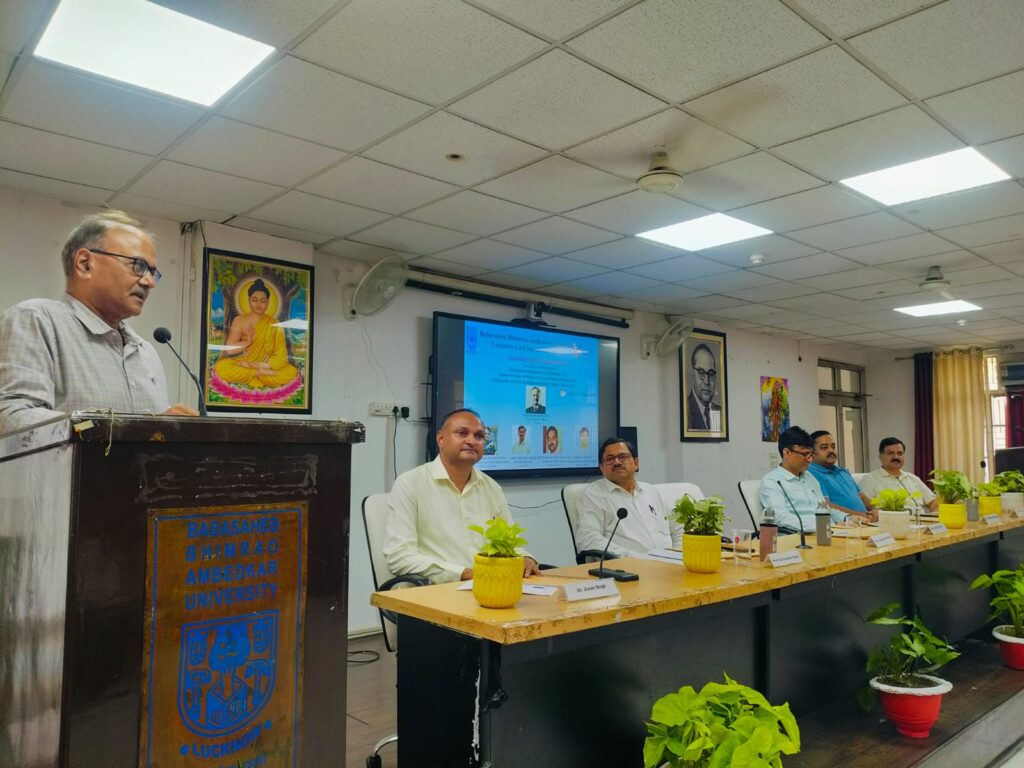
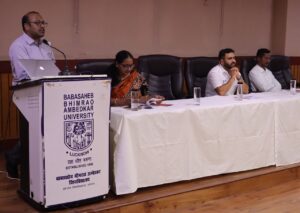
Lucknow: A two-day workshop on “Prototype Development and Validation Clinic” was inaugurated on August 13 at Babasaheb Bhimrao Ambedkar University (BBAU), Lucknow, under the aegis of the Institution’s Innovation Council and organized by the Research and Development Cell. The programme was chaired by the Vice Chancellor of the University, Prof. Raj Kumar Mittal. Prof. Naveen Kumar Arora, President, Institution Innovation Council, BBAU, Dr. Pankaj Kumar Srivastava, Scientist-G, CSIR-National Botanical Research Institute, Lucknow, Prof. Bal Chandra Yadav, Prof. Shishir Kumar, Director, Research and Development Cell and Dr. Jeevan Singh, Programme Coordinator were present on the dais. The programme commenced with the lighting of the ceremonial lamp and floral tribute to the portrait of Babasaheb Dr. B. R. Ambedkar. Thereafter, members of the organizing committee welcomed the faculty members by presenting them with saplings. Prof. Bal Chandra Yadav extended a welcome to all the participants. This was followed by an overview of the objectives and structure of the programme by Dr. Jeevan Singh, the Programme Coordinator.
Addressing the gathering, Vice Chancellor Prof. Raj Kumar Mittal said that the Government is giving special importance to the areas of research and development during the formulation of the national budget. As a result, investment and budgetary allocations in research and development-related fields have been witnessing a continuous increase. He stated that major financial support for research is still received from the public sector, and therefore, greater efforts are required to connect research and innovation with the needs of society and industry. Prof. Mittal observed that India has emerged as a major consumer in the field of information technology, but the need of the hour is to move beyond being merely a consumer and progress towards becoming a producer. For this, the country needs to develop new products and technologies that can establish a global identity and generate new employment opportunities. He emphasized that the objective of research should not be limited to the creation of new knowledge; it is equally important to transform research outcomes into practical solutions capable of addressing real-world problems faced by society and the nation. He urged researchers to develop the capacity to solve problems and utilize science and technology to meet the needs of society. The Vice Chancellor said that the true purpose of science and technology can be realized only when research and technology play an effective role in solving the actual problems faced by people.
Prof. Naveen Kumar Arora, President, Institution Innovation Council, BBAU, provided detailed information about the various initiatives being undertaken by the University through the Institution Innovation Council. He stated that continuous efforts are being made through Navkalpana, a Section 8 company, to promote innovation and new ideas at the University. Under these initiatives, students and faculty members are being encouraged to work towards new ideas, technological innovations and their practical applications. He emphasized that Navkalpana and the Research and Development Cell should work together to make research and innovation at the University more effective. Through coordinated efforts, research outcomes can be transformed into innovations, prototypes and useful technological solutions. He further stated that strengthening a culture of innovation is essential to ensure that the research and expertise available at the University reach society and industry. On the occasion, he encouraged faculty members and students to associate themselves with Navkalpana and work towards giving practical shape to their innovative ideas and research.
Dr. Pankaj Kumar Srivastava, Scientist-G, CSIR-National Botanical Research Institute, Lucknow, stated that in order to transform a technological idea into a useful and functional form, it is necessary to integrate it with scientific knowledge and develop it under real-world conditions. He said that the practical application of technical knowledge plays an important role throughout the process, from developing an idea to preparing a working model and conducting reliable testing. During his address, he discussed Scientific Feasibility, Engineering Feasibility and the feasibility of implementing technology at the real-world level in detail. He explained that for the successful development of any technology, it is essential to assess its scientific usefulness and viability, the technical capability required for its construction and operation, and its effectiveness in being implemented under actual conditions.
At the conclusion of the programme, the Vice Chancellor and the guests were presented with traditional stoles and books by the organizing committee as a gesture of gratitude. Faculty members, non-teaching staff, research scholars and students were present during the programme.



 ---------------------------------------------------------------------------------------
 ----------------------------------------------------------------------------------------
 ---------------------------------------------------------------------------------------------
------
---------------------------------------------------------------------------------------------
---------------------------------------------------------------------------------------------------