
Two-Day National Media Workshop Concludes at BBAU: Deliberations Held on Emerging Media Challenges and Innovation
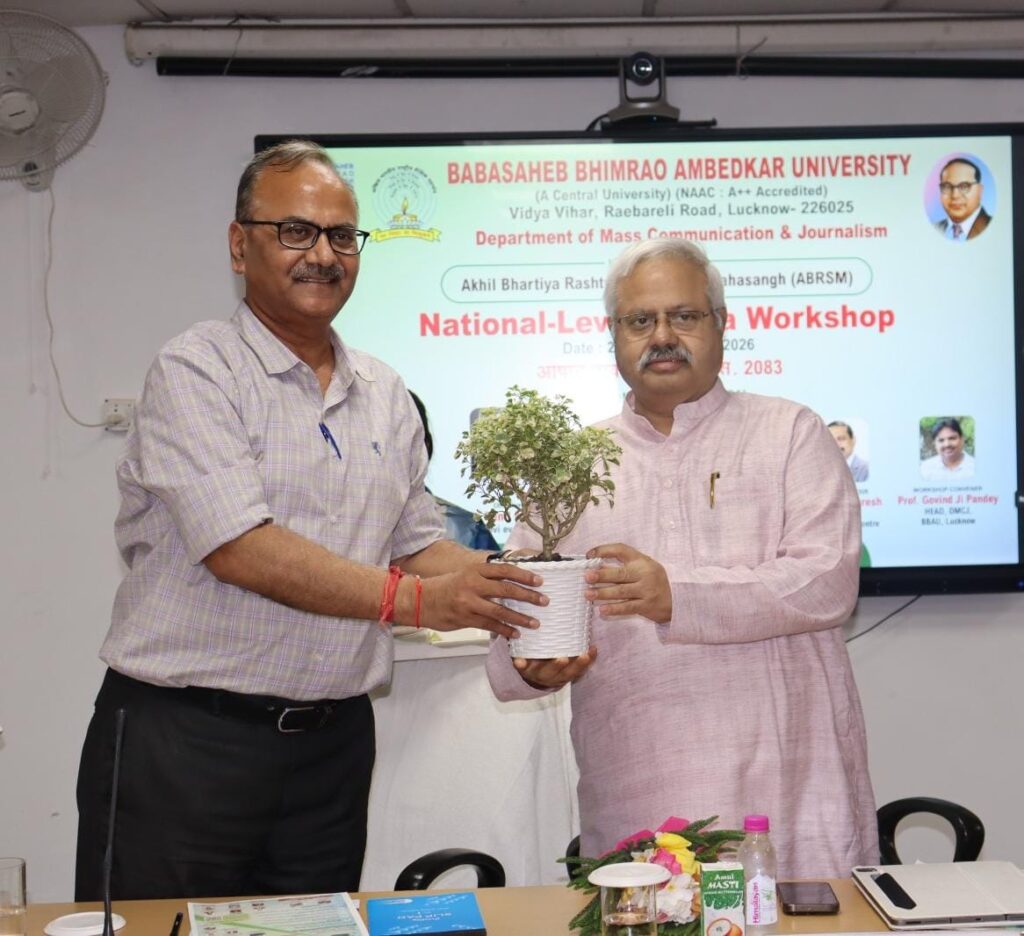
A two-day National Media Workshop, jointly organised by the Department of Mass Communication and Journalism, Babasaheb Bhimrao Ambedkar University (BBAU), and the Akhil Bharatiya Rashtriya Shaikshik Mahasangh, concluded on 26 July at the BBAU. The valedictory session was presided over by the Vice-Chancellor, Prof. Raj Kumar Mittal. Shri Sunil Ambekar, Akhil Bharatiya Prachar Pramukh of the Rashtriya Swayamsevak Sangh (RSS), graced the occasion as the Chief Guest. Apart from this, Prof. N. L. Gupta, President, Akhil Bharatiya Rashtriya Shaikshik Mahasangh, Prof. Geeta Bhatt, General Secretary, Shri G. Lakshman, Sah Sangathan Mantri and Prof. Govind G. Pandey, Head of the Department of Mass Communication and Journalism, BBAU were present on the dais. The successful organisation of the workshop was supported significantly by Prof. Sanjay K. Dwivedi. The programme commenced with the ceremonial lighting of the lamp and floral tributes to Goddess Saraswati and Bharat Ratna Babasaheb Dr. B. R. Ambedkar. Prof. Govind G. Pandey welcomed the dignitaries and participants and outlined the objectives and structure of the workshop.
In his presidential address, Vice-Chancellor Prof. Raj Kumar Mittal congratulated the organising committee on the successful conduct of the two-day National Media Workshop. He observed that media has become one of the most influential platforms for shaping public opinion, creating social awareness, and disseminating information. Therefore, it is essential for media professionals and students to understand emerging technologies, digital platforms, and the evolving media landscape. He stated that while this is the age of technology, it must be used with wisdom, ethical values, and social responsibility. He emphasised that factual, impartial, and responsible journalism forms the foundation of media credibility. Prof. Mittal further remarked that Artificial Intelligence (AI) and modern technologies can significantly strengthen journalism, provided they are used purposefully and in accordance with human values. He urged participants to continuously upgrade their knowledge, acquire proficiency in new media technologies, and contribute to building a responsible and credible media ecosystem rooted in Indian knowledge traditions, social concerns, and national interest.
Addressing the gathering, Chief Guest Shri Sunil Ambekar stressed that in the present era of information and communication, it is imperative to provide society with accurate, factual, and authentic information. He said that fact-based communication is the most effective means of safeguarding society against misinformation and false narratives. He called upon media professionals and academicians to verify facts before disseminating information and to promote positive, responsible, and nation-oriented discourse. Speaking on the concept of Bharatiyata (Indianness), Shri Ambekar emphasised the need to accord due importance to the Indian perspective, Indian values, and cultural heritage within the education system. He stated that Indianness should not remain confined to ideas alone but should also be reflected in everyday conduct and lifestyle. He advocated aligning the fundamental philosophy of education with the changing needs of the times through modern technology and innovation. He further encouraged the promotion of indigenous thinking, the Indian knowledge tradition, and nation-oriented education, asserting that only the collective efforts of teachers, parents, and the younger generation can build a value-based, aware, and self-reliant society.
On this occasion, a technical session on “Introduction to Modern Media Dynamics and Content Writing Fundamentals” was conducted under the chairmanship of Prof. K. G. Suresh, Director of India Habitat Centre. In his lecture, Prof. Suresh compared the “Before Google (BG)” and “After Google (AG)” eras, explaining how the digital revolution has fundamentally transformed the creation, dissemination, and consumption of information.
Another technical session on “Fact-Checkil” was chaired by Dr. Ravi Suryavanshi, Department of Mass Communication and Journalism, University of Allahabad. He familiarised participants with various fact-checking techniques and methods for identifying credible sources, emphasising that responsible and fact-based journalism is the need of the hour.
A special video presentation showcasing the major sessions, activities, and achievements of the two-day workshop was also screened during the valedictory programme.
The programme concluded with a vote of thanks proposed by Prof. Geeta Bhatt. Among those present were Prof. Mahendra Kumar Padhi, Prof. Rachana Gangwar, Dr. Arvind Singh, Dr. Loknath Singh, Dr. Kunwar Surendra Bahadur, other faculty members, and members of the Akhil Bharatiya Rashtriya Shaikshik Mahasangh.



 ---------------------------------------------------------------------------------------
 ----------------------------------------------------------------------------------------
 ---------------------------------------------------------------------------------------------
------
---------------------------------------------------------------------------------------------
---------------------------------------------------------------------------------------------------