
Three-Day National Conference on Panchakosha-Based Education Inaugurated at BBAU; Emphasis on Holistic Development of Students
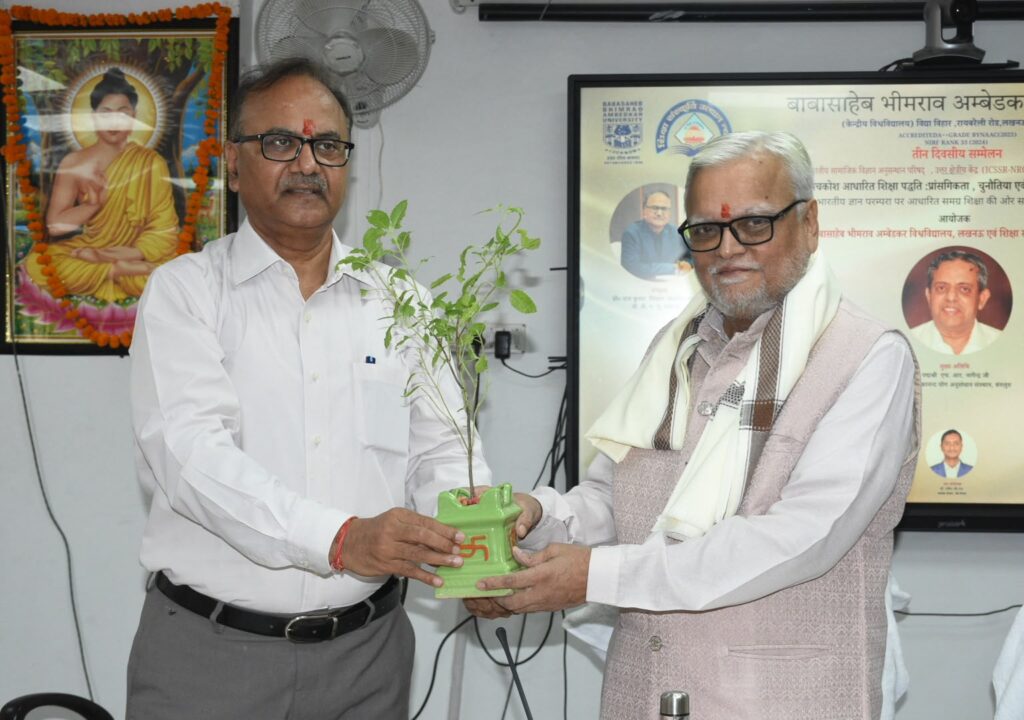
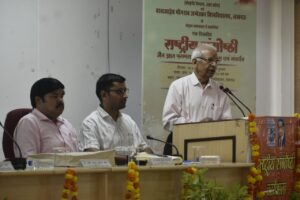
Lucknow: Babasaheb Bhimrao Ambedkar University (BBAU) inaugurated a three-day national conference on 14 October on the theme “Panchakosha-Based Education System: Relevance, Challenges and Implementation.” The conference is being jointly organised by the Department of Yoga, BBAU, and Shiksha Sanskriti Utthan Nyas, New Delhi, with sponsorship from the Indian Council of Social Science Research (ICSSR), Northern Regional Centre, New Delhi. The inaugural session was presided over by the Vice-Chancellor of the University, Prof. Raj Kumar Mittal. Padma Shri Prof. H. R. Nagendra, President of the Vivekananda Yoga Anusandhana Samsthana, Bengaluru, Karnataka, attended as the Chief Guest. Other dignitaries on the dais included the keynote speaker, Dr. Atul Kothari, Rashtriya Sachiv of Shiksha Sanskriti Utthan Nyas, New Delhi, Prof. B. C. Yadav, Dean of the School of Yoga, Naturopathy and Cognitive Studies and Dr. Narendra Singh, Convener of the conference. The programme commenced with the ceremonial lighting of the lamp and floral tributes to Babasaheb Dr. B. R. Ambedkar. Following the rendition of the University anthem, the organising committee expressed its gratitude to the dignitaries and faculty members by presenting them with tulsi plants, mementoes and shawls. Prof. B. C. Yadav, Dean of the School, welcomed all the participants. Subsequently, Dr. Deepeshwar Singh, Head of the Department of Yoga, outlined the objectives and programme of the conference. The proceedings were conducted by Dr. Ramesh Chandra Nailwal.
Vice-Chancellor Prof. Raj Kumar Mittal highlighted the significance of the Panchakosha principle and stated that it presents a comprehensive framework for establishing harmony among the human body, mind and consciousness. He emphasised the need to understand this principle, rooted in the Indian knowledge tradition, in depth and incorporate its relevance into contemporary life. Drawing a comparative analysis of Indian and Western philosophies, he observed that Indian philosophy, through its culture, civilisation, yoga and knowledge systems, seeks to unite the world and promote the welfare of all, whereas several modern Western philosophical approaches place greater emphasis on material progress and consumption. He stated that the fundamental objective of Indian philosophy is to cultivate balance, restraint, cooperation and collective well-being in human life, making it even more relevant in the present era. Prof. Mittal also discussed the growing influence of science, technology and artificial intelligence on human life. He emphasised that preserving human values, ethics and inner balance is essential in an age of rapid technological advancement. Technology, he said, should be used to improve human life while safeguarding and promoting the fundamental principles of the Indian knowledge tradition. Encouraging young people, he called upon them to become ambassadors of India’s yoga culture and knowledge tradition and communicate their scientific, cultural and practical significance to society. He added that integrating yoga and Indian philosophy with modern scientific perspectives could help build a society that gives equal importance to physical health, mental peace, ethical awareness and social harmony.
Chief Guest Padma Shri Prof. H. R. Nagendra, President of the Vivekananda Yoga Anusandhana Samsthana, Bengaluru, Karnataka, delivered an address on “The Panchakosha Principle and Education in the Taittiriya Upanishad,” elaborating on the scientific dimensions of yoga. Explaining the Panchakosha principle, he stated that the holistic development of human personality can be understood through the five koshas: Annamaya Kosha, Pranamaya Kosha, Manomaya Kosha, Vijnanamaya Kosha and Anandamaya Kosha. He emphasised that yoga is not limited to physical health but is also a powerful means of promoting mental, emotional, intellectual and spiritual development. In this context, he discussed the structure of Pranamaya Kosha and the importance of pranayama, referring to the traditional Indian yogic concept of 72,000 nadis. He explained that the Panchakosha principle offers a holistic framework for understanding human life and encourages an educational approach that extends beyond intellectual development to encompass all dimensions of personality. Referring to Newton’s laws of motion, Prof. Nagendra observed that scientific principles are relevant not only to scientific experiments and technological advancements but also to the practical aspects of everyday life. He noted that India has adopted several Western models of science and technology, but the need of the hour is to strengthen scientific approaches and research models rooted in the Indian knowledge tradition. Describing yoga as a multidimensional discipline, he stated that it plays an important role in establishing harmony among the body, mind, emotions and inner consciousness. He added that integrating yoga and the Panchakosha principle, rooted in India’s knowledge tradition, with modern scientific understanding and the education system could contribute significantly to holistic human development, a balanced life and overall well-being.
Keynote speaker Dr. Atul Kothari, Rashtriya Sachiv of Shiksha Sanskriti Utthan Nyas, New Delhi, spoke on “The Indian Educational Tradition and the Need for Panchakosha-Based Teaching.” He stated that the purpose of universities is not merely to award degrees but also to foster the holistic development of students and prepare them to become responsible, sensitive and exemplary citizens. He emphasised that the Indian knowledge tradition, culture, civilisation and philosophy should be given appropriate representation in the education system so that young people remain connected to their roots and imbibe Indian values. Highlighting the need for Panchakosha-based teaching, he stated that education should ensure the physical, mental, intellectual, emotional and spiritual development of students. This approach can make education more practical, value-oriented and rooted in ethical and cultural principles, rather than restricting it to textbook knowledge. Dr. Kothari particularly emphasised five guiding principles for a happy and balanced life: Sangeet (music), Swadhyaya (self-study), Seva (service), Sanyam (self-restraint) and Satsang (association with good company). He also called upon educational institutions to promote the Indian knowledge tradition and life values so that young people develop not only into knowledgeable individuals but also into value-driven, dutiful and socially committed citizens.
On the occasion, a documentary on the Panchakosha principle, prepared by the University’s Media Centre, was screened. The documentary presented the Panchakosha concept, its various dimensions and its significance in human life. The inaugural session concluded with a vote of thanks by Dr. Narendra Singh, Convener of the conference.
A special lecture session was also organised during the programme under the chairpersonship of Prof. Rajsharan Shahi, Head of the Department of Education and Dean of the School. Dr. Atul Kothari and Prof. Shilpi Verma, Director of the Internal Quality Assurance Cell (IQAC), BBAU, were present as speakers. In addition, research scholars presented their research papers under the chairpersonship of Mr. Sanjay Swami, Rashtriya Seh Sanyojak of Shiksha Sanskriti Utthan Nyas, New Delhi. A panel discussion on “National Education Policy 2020 and the Panchakosha-Based Teaching Model” was also organised, during which experts held detailed deliberations on various aspects of the subject.
Faculty members, Deans, Heads of Departments, non-teaching staff, research scholars and students from various schools and departments of the University attended the programme.














 https://www.youtube.com/watch?si=RtToJsBhYBatUrym&v=mOuYNSdhjHA&feature=youtu.be