
National Seminar on the Role of Cooperatives in Strengthening Rural Development and Future Prospects Held at BBAU

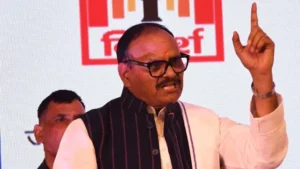
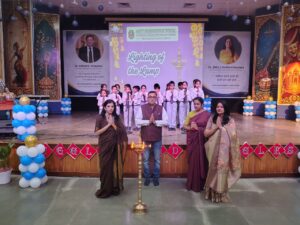
Lucknow: Babasaheb Bhimrao Ambedkar University (BBAU), Lucknow, organised a national seminar on November 18, 2026, through its Department of Economics, in collaboration with the Indian Farmers Fertiliser Cooperative Limited (IFFCO). The seminar was organised on the theme, “Future of Cooperation and Emerging Role of Cooperatives in Strengthening the Rural Development of India with Special Reference to Uttar Pradesh.” The programme was presided over by the Vice-Chancellor of the University, Prof. Raj Kumar Mittal. Dr. K.K. Tripathi, Joint Secretary, Economic Advisory Council to the Prime Minister (EAC-PM), attended the seminar as the keynote speaker. Other distinguished guests included Prof. Sanjay Verma from the Indian Institute of Management, Ahmedaba, Prof. Ved Prakash Tripathi from Dr. B.R. Ambedkar University, Agra, Prof. S. Victor Babu, Dean of Academic Affairs, Prof. Sanatan Nayak, Head of the Department of Economics, BBAU and Prof. Om Prakash Shukla, the programme convenor. The programme commenced with the ceremonial lighting of the lamp and floral tributes to the portrait of Bharat Ratna Dr. B.R. Ambedkar. This was followed by the University Kulgeet. The organising committee welcomed the distinguished guests and faculty members by presenting them with bouquets, mementoes and shawls. At the outset, Programme Convenor Prof. Om Prakash Shukla welcomed all the dignitaries and participants. Subsequently, Prof. Sanatan Nayak briefed the audience about the objectives and outline of the seminar.
Addressing the gathering, Vice-Chancellor Prof. Raj Kumar Mittal emphasised that the cooperative movement plays a vital role in strengthening rural development and ensuring inclusive economic growth in India. He stated that cooperation is not merely limited to economic activities but represents a broader philosophy rooted in social harmony, collective responsibility and mutual support. Expressing his views, he remarked, “Without values, there can be no upliftment, and without cooperation, there can be no values.” He explained that the cooperative model offers a more inclusive alternative to capitalism by prioritising collectivity, participation and shared development over individualism. He further emphasised that in the present era, economic growth must go hand in hand with environmental and social sustainability to ensure long-term and inclusive development. Referring to the Sanskrit verse “Sangachchhadhwam Samvadadhwam Sam Vo Manansi Janatam”, he highlighted the importance of collective thinking, dialogue and unity as the fundamental principles of the cooperative movement. The Vice-Chancellor also encouraged young people not to limit their aspirations to becoming job seekers but to strive towards becoming job creators. He stressed the need to embrace entrepreneurship, innovation and opportunities associated with cooperative institutions. Expressing confidence in the potential of youth, he said that their talent and skills must be channelled towards employment generation, strengthening the rural economy and promoting collective development to realise the vision of an Atmanirbhar and Viksit Bharat.
Dr. K.K. Tripathi, Joint Secretary, Economic Advisory Council to the Prime Minister (EAC-PM), shared his views on the theme “Democratic Framework in Governance and Professionalism in Management.” He stated that the long-term success and sustainability of any institution depend on strong institutional frameworks and effective management systems. He emphasised that institutions progress not merely on the basis of capital but through robust institutional structures, discipline, transparency and credibility. Speaking about cooperative institutions, he explained that cooperation instils a sense of ownership among members, while corporate governance ensures discipline and credibility within an organisation. He further highlighted that cooperative institutions are built not merely on financial capital but also on good character, mutual trust and collective values. He identified effective operational systems under CEO leadership, financial transparency and regular audits, KPI-based performance assessment, skill development and deliberations among leaders as essential elements for institutional strengthening. He concluded by stating that good governance is not merely a process but an institutional work culture and a continuously practised habit that plays a crucial role in making organisations more efficient, accountable and sustainable.
Prof. Sanjay Verma from the Indian Institute of Management, Ahmedabad, highlighted the economic and social significance of cooperation. He stated that cooperation is a system in which individuals work not only for their own development but also for the welfare and interests of others associated with them. In this way, cooperation transforms individual efforts into collective strength and plays an important role in promoting economic activities. He explained that through the cooperative system, individuals contribute directly and indirectly to building a strong economy. This approach encourages mutual support, shared responsibility and the efficient utilisation of resources, thereby expanding economic opportunities in rural areas and creating new avenues for employment and livelihood at the grassroots level. He emphasised that the true objective of cooperation is to facilitate collective development and economic empowerment through joint efforts.
Prof. Ved Prakash Tripathi from Dr. B.R. Ambedkar University, Agra, discussed the social and ideological significance of cooperation. He stated that a society in which the philosophy of cooperation flourishes emerges as an ideal society. He emphasised that the progress of any society cannot be assessed solely on the basis of its financial and economic growth; its social achievements and development must also be taken into consideration. Cooperation is not merely a means of accelerating economic activities but also strengthens mutual trust, self-confidence, participation and collective responsibility within society. He further explained that when people work together towards a common objective, they develop decision-making abilities, leadership skills and a stronger sense of social belonging. Thus, cooperation plays a significant role in building a better and self-reliant society by promoting social harmony, inclusivity and collective empowerment alongside economic development.
At the conclusion of the programme, Prof. S. Victor Babu delivered the vote of thanks. A panel discussion was also organised during the seminar to deliberate upon various dimensions of cooperation, its role in rural development and its future prospects.
Faculty Deans, Heads of Departments, faculty members, non-teaching staff, research scholars and students from various departments and faculties of the University attended the programme.












 https://www.youtube.com/watch?si=RtToJsBhYBatUrym&v=mOuYNSdhjHA&feature=youtu.be