
Major Achievement by BBAU Department of Chemistry Researchers: New Green Metal-Free Technology Developed for Producing Key Chemical Building Blocks of Life-Saving Drugs, Granted Indian Patent
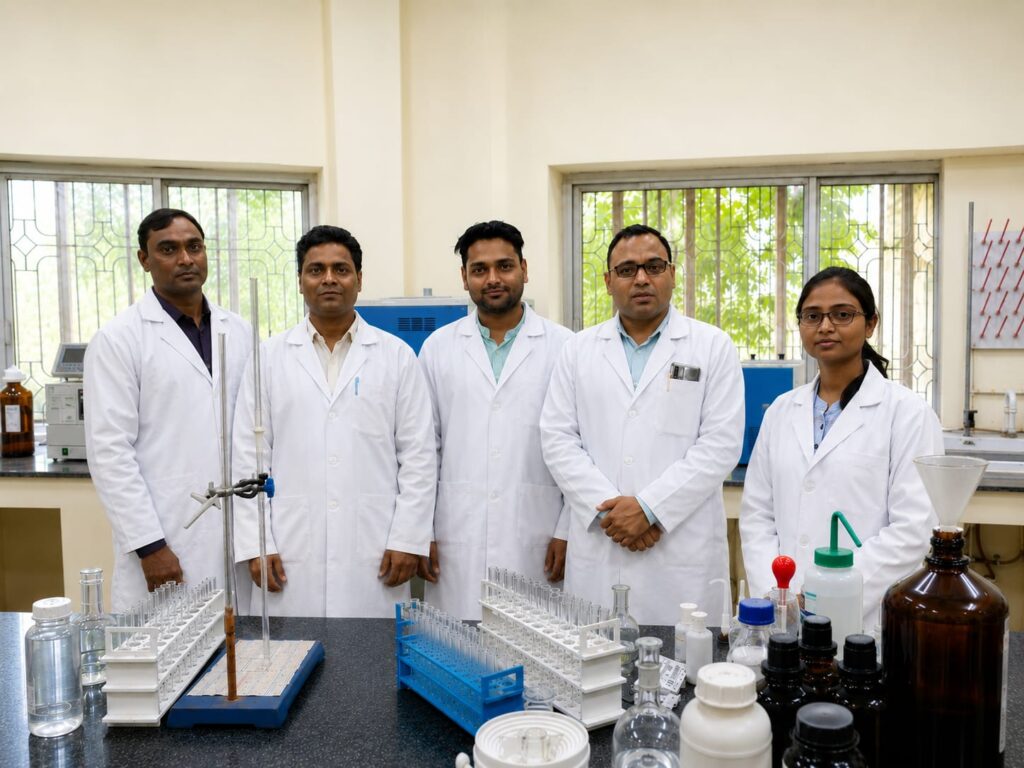
Lucknow: Under the scientific leadership and guidance of Dr. Jawahar Lal Jat of the Department of Chemistry, Babasaheb Bhimrao Ambedkar University (BBAU), Lucknow, research scholar Dr. Puneet Kumar, along with other members of the research team, has developed a novel, simple, and environmentally friendly method for the synthesis of primary amines. This innovation has been granted an Indian Patent (Patent No. 595951) by the Government of India Patent Office under the title “Method for Metal-Free Direct Transformation of Aryl Boronic Acid to Primary Amines”. On this occasion, Vice-Chancellor Prof. Raj Kumar Mittal congratulated the research team and described the achievement as a matter of great pride for the University.
Dr. Jawahar Lal Jat played a pivotal role in conceptualizing the research, designing the study, developing the novel synthetic methodology, and providing scientific guidance, while research scholar Dr. Puneet Kumar made significant contributions through experimental research, process development, optimization, and validation. Their collaborative efforts resulted in the development of this innovative metal-free technology, which has now been awarded an Indian patent by the Government of India.
Nitrogen plays a crucial role in modern drug discovery. According to scientific studies, nearly 82% of the new drugs approved by the U.S. Food and Drug Administration (US FDA) over the past decade contain at least one nitrogen atom. Consequently, incorporating nitrogen into biologically active molecules has become one of the foremost research objectives of organic chemists worldwide. Nitrogen-containing compounds are essential in the development of medicines for cancer, diabetes, bacterial infections, hypertension, cardiovascular diseases, neurological disorders, and several other medical conditions.
Although numerous synthetic methods have been developed globally for the preparation of such compounds, most existing processes rely on expensive metal catalysts, high temperatures, harsh reaction conditions, or multi-step procedures. Moreover, direct conversion of abundantly available aryl boronic acids into primary amines remains extremely limited.
Primary amines are regarded as fundamental building blocks in modern organic chemistry. They serve as essential starting materials for the synthesis of thousands of pharmaceuticals, agrochemicals, and specialty chemicals worldwide. Many important medicines currently available on the market—including antibiotics, anticancer drugs, antidiabetic medicines, antihypertensive drugs, and neurological therapeutics—are synthesized using primary amines as key intermediates. They are also extensively used in the manufacture of pesticides, herbicides, dyes, polymers, electronic materials, specialty plastics, and numerous industrial chemicals.
Until now, industrial production of primary amines has largely depended on metal catalysts such as Palladium (Pd), Nickel (Ni), Copper (Cu), and Iron (Fe). These conventional technologies suffer from several drawbacks, including the use of costly catalysts, complex multi-step procedures, contamination of products with residual metals, additional purification requirements in pharmaceutical manufacturing, environmental concerns, and increased production costs. Even trace amounts of residual metals are considered a significant quality and safety challenge in the pharmaceutical industry.
The technology developed by BBAU scientists enables the direct conversion of readily available aryl boronic acids into primary amines without the use of any metal catalyst. This makes the entire process simpler, safer, and more environmentally friendly. One of its most significant advantages is that the reaction proceeds in a single step under mild reaction conditions, eliminating the need for expensive metal catalysts. The method yields comparatively purer products while completely avoiding the problem of metal contamination. As a result, the process aligns well with the principles of Green Chemistry and has strong potential for future industrial-scale applications owing to its simplicity, cost-effectiveness, and clean methodology.
Experts believe that this invention could have far-reaching implications. A reduction in the cost of amine synthesis may significantly lower the manufacturing costs of numerous pharmaceuticals. Furthermore, minimizing the use of metal catalysts would reduce chemical waste and industrial pollution. The technology reinforces the principles of Green Chemistry, which emphasize cleaner, energy-efficient, and low-waste chemical processes. In addition, the development of indigenous technologies for the pharmaceutical and specialty chemical industries could strengthen India’s global competitiveness. The innovation is also expected to promote collaboration among universities, research institutions, and industries while creating new opportunities for technology transfer and startup ventures.
Experts further opine that industrial adoption of this technology could provide substantial benefits to the pharmaceutical manufacturing sector by reducing dependence on metal catalysts, lowering production costs, enhancing process safety, and minimizing environmental pollution. It may also strengthen India’s pharmaceutical, agrochemical, and specialty chemical industries in the global market. Moreover, this innovation provides strong scientific support to national initiatives such as “Atmanirbhar Bharat” and “Make in India.”







 ---------------------------------------------------------------------------------------
 ----------------------------------------------------------------------------------------
 ---------------------------------------------------------------------------------------------
------
---------------------------------------------------------------------------------------------
---------------------------------------------------------------------------------------------------