
Yoga Promotes Physical Health, Mental Stability and Spiritual Growth: Special Lecture Organised at BBAU
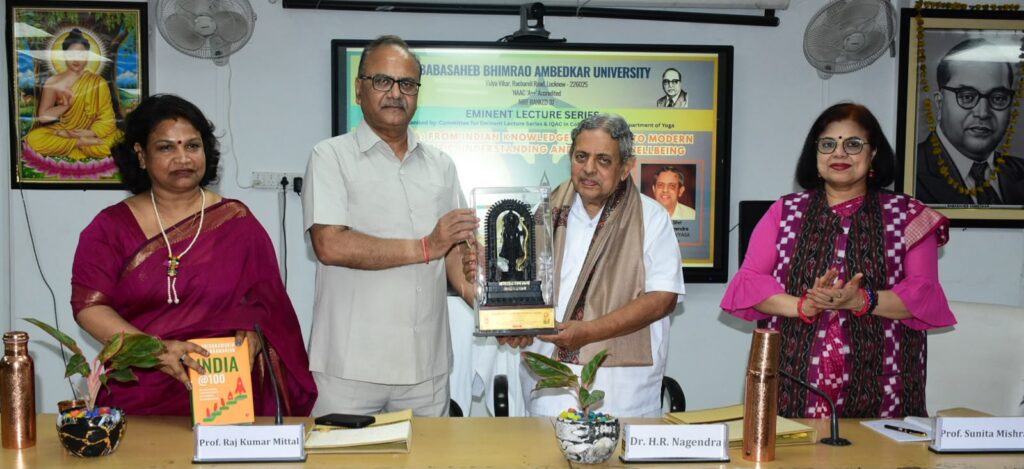
Lucknow: Babasaheb Bhimrao Ambedkar University organised a special lecture on 13 October under the Eminent Lecture Series, conducted by the Eminent Lecture Series Committee, on the theme “Yoga: From Indian Knowledge Tradition to Modern Scientific Understanding and Holistic Well-Being.” The programme was presided over by the Hon’ble Vice-Chancellor of the University, Prof. Raj Kumar Mittal. Padma Shri Dr. H. R. Nagendra, President of Swami Vivekananda Yoga Anusandhana Samsthana, attended the programme as the Chief Guest. Apart from this, Prof. Sunita Mishra and Prof. Shilpi Verma, Chairperson of the Eminent Lecture Series Committee, were also present on the dais. The programme commenced with the lighting of the ceremonial lamp and the offering of floral tributes to the portrait of Babasaheb. This was followed by the University Anthem. The organising committee expressed its gratitude to the Chief Guest by presenting him with a sapling. At the outset, Prof. Shilpi Verma welcomed all the dignitaries and participants and apprised them of the objectives and outline of the programme. The proceedings were conducted by Dr. Sudarshan Chakradhari.
Addressing the gathering, the Hon’ble Vice-Chancellor, Prof. Raj Kumar Mittal, highlighted the significance of yoga and the Indian knowledge tradition. He stated that yoga is an integral part of Indian culture and civilisation, inspiring individuals towards self-reflection, self-realisation and social welfare. He emphasised that, within the Indian knowledge tradition, yoga is not limited to physical exercises but serves as a means of establishing harmony among the body, mind and soul. While certain trends in modern Western thought focus on consumerism and material achievements, the Indian knowledge tradition advocates inner peace, ethical values and collective well-being. Prof. Mittal urged young people to remain connected with their cultural heritage, traditional knowledge and the ancient tradition of yoga, and to incorporate their ideals into their lives. He stressed that the pursuit of modernity and rapid progress should not come at the cost of ethical and human values. Yoga teaches discipline, self-restraint, tolerance and harmony, which are essential for developing a balanced personality and building a healthy and harmonious society. He further emphasised that by incorporating the principles of yoga into their daily lives, young people can not only improve their physical and mental well-being but also strengthen social harmony, human sensitivity and the spirit of global welfare.
The Chief Guest and keynote speaker, Padma Shri Dr. H. R. Nagendra, stated that yoga is akin to a revolution, with the potential to bring about positive and far-reaching transformations in human life. He observed that the importance of yoga has increased considerably amid the rapid changes taking place in modern society. Yoga brings about both external and internal transformations in an individual. While visible changes are reflected in physical health, physical capabilities and work patterns, the invisible changes are associated with inner consciousness, mental well-being, emotional balance and spiritual development. Explaining the concept of the Panchakosha in detail, Dr. Nagendra stated that the holistic development of the five sheaths—Annamaya Kosha, Pranamaya Kosha, Manomaya Kosha, Vijnanamaya Kosha and Anandamaya Kosha—helps an individual enhance their overall personality. He clarified that yoga is not merely a form of physical exercise but a comprehensive way of life that establishes harmony among the body, mind and consciousness. Dr. Nagendra also elaborated on the eight limbs of Ashtanga Yoga Yama, Niyama, Asana, Pranayama, Pratyahara, Dharana, Dhyana and Samadhi. He explained that their regular practice enables individuals to achieve physical well-being, mental stability and spiritual growth. Highlighting the scientific significance of yoga, he stated that it can play an important role in stress management, improving concentration, maintaining emotional balance and promoting mental well-being in contemporary times. Referring to young people, he explained that yoga is an effective means of calming the mind and regulating its restless tendencies. Furthermore, he elaborated on Swami Vivekananda’s renowned statement, “Each soul is potentially divine,” explaining that every individual possesses immense potential, which can be realised and developed through self-discipline, spiritual practice and yoga.
At the conclusion of the programme, the organising committee expressed its gratitude to the Chief Guest by presenting him with a memento and a shawl. Prof. Sunita Mishra delivered the vote of thanks.
Deans of various faculties, heads of departments, faculty members, non-teaching staff, research scholars and students attended the programme.












 https://www.youtube.com/watch?si=RtToJsBhYBatUrym&v=mOuYNSdhjHA&feature=youtu.be