
BBAU Organizes EEG Workshop, Experts Share Insights on Neuroscience and Brain-Computer Interface Applications
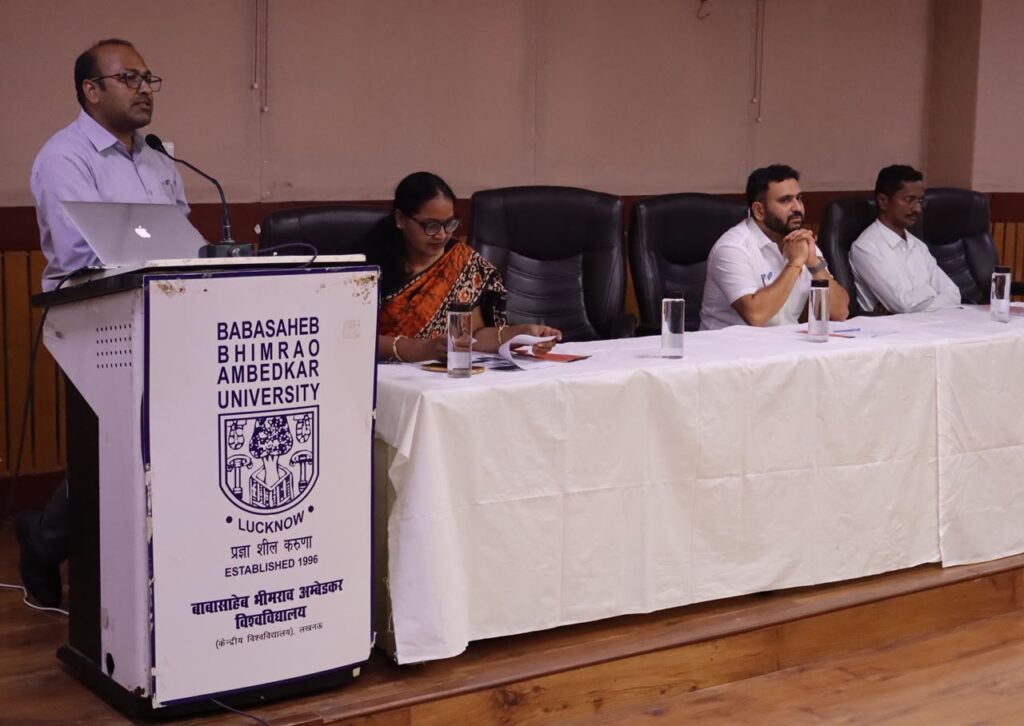
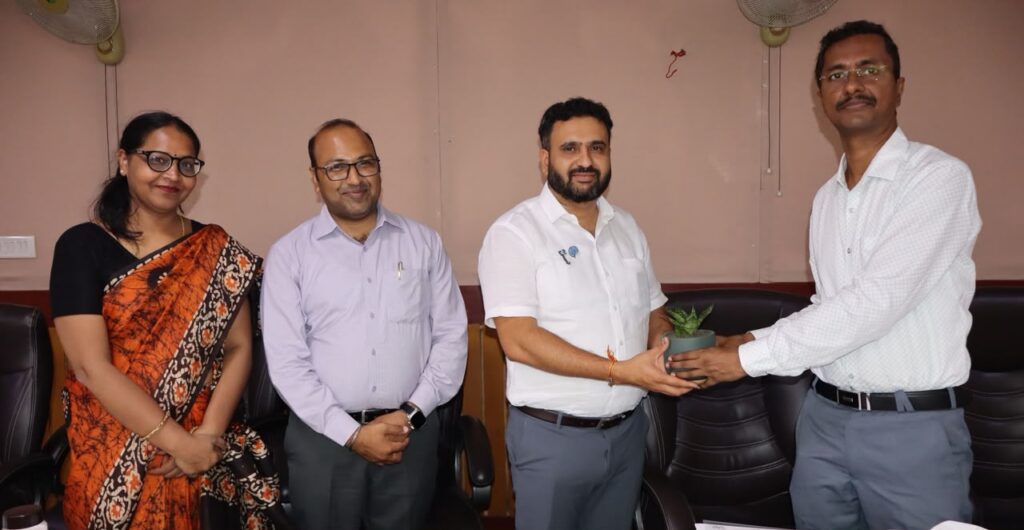
Lucknow: Babasaheb Bhimrao Ambedkar University (BBAU), Lucknow, organized a one-day workshop titled “BRAIN POTENTIAL: THE EEG WORKSHOP – Exploring Brain Signals for Scientific Discovery and Real-World Applications” on October 6. The workshop was organized by the Department of Yoga, School of Yoga, Naturopathy and Cognitive Studies with the objective of developing an understanding of brain signals, Electroencephalography (EEG), and its real-world applications. Dr. Suhas Vinchurkar from Magstim EGI, USA, attended the workshop as the Chief Guest. Dr. Deepeshwar Singh, Head, Department of Yoga, Prof. Babita Pandey, Coordinator, Centre of Excellence for AI, BBAU and Dr. Naveen G. H were also present on the dais. The programme commenced with the ceremonial lighting of the lamp and floral tribute to the portrait of Babasaheb Dr. B. R. Ambedkar. This was followed by the University Kulgeet. The organizing committee expressed its gratitude to the Chief Guest and faculty members by presenting them with saplings. At the beginning, Dr. Depeshwar Singh welcomed all the guests and participants and apprised them of the objectives and outline of the workshop.
Chief Guest and Magstim EGI, USA representative Dr. Suhas Vinchurkar said that EEG technology helps in understanding the electrical activity of the brain and its various signals in a scientific manner. He stated that in the present era, technologies such as EEG, ERP and Brain-Computer Interface (BCI) are gaining increasing importance in the field of neuroscience. These technologies can help in understanding brain functioning while also opening up new possibilities in research, education, mental health and various real-world applications. Dr. Vinchurkar said that such workshops provide an effective platform for students and researchers to gain practical exposure to advanced neuroscience technologies. He also emphasized the need to understand the scientific and responsible use of EEG, along with aspects such as neural privacy, informed consent and ethical considerations. He said that such training in academic institutions provides young researchers with opportunities to work with emerging technologies and promote innovation in the fields of neuroscience and brain-computer interfaces.
Dr. Deepeshwar Singh, Head, Department of Yoga, said that in the present era, understanding brain functioning and improving mental health are among our key priorities. He explained that Electroencephalography is a safe, non-invasive and painless neuroimaging technique in which electrodes are placed on the scalp to record the electrical activity of the brain and changes in voltage with high temporal resolution, measured in milliseconds. He stated that the technique enables detailed analysis of different brain waves, including delta waves associated with deep sleep and recovery, theta waves associated with attention and memory, alpha waves associated with relaxed awareness, and beta waves associated with active thinking and concentration. Dr. Vinchurkar stated that the objective is not only to establish new dimensions in medical and clinical research through modern neuroscience technologies, but also to improve mindfulness, stress management and cognitive performance in everyday life, thereby contributing towards a healthier and more aware society.

A total of four sessions were conducted during the programme, covering important topics such as EEG, neuronal conduction and BCI, along with live demonstrations. The first session focused on the fundamental principles of EEG and brain signals. The second session covered neuronal conduction and the functioning of action potentials. The third session highlighted Evoked Potentials (EP), Event-Related Potentials (ERP), and their research applications in the social sciences. The fourth session began with an EEG demonstration and included various practical activities. Following the practical demonstration, key learning points were discussed and a question-and-answer session was organized for the participants. At the conclusion of the programme, participants shared their experiences and feedback.
The workshop provided information on the fundamental principles of EEG, acquisition of EEG and ERP data, analytical protocols for identifying indicators of brain functioning, applications of Brain-Computer Interface (BCI) and neuromodulation, selection of equipment for laboratory and field applications, and practical training from academic and industry experts. Important aspects such as ethics in BCI, neural privacy, informed consent, safety and the responsible use of brain-computer interfaces were also discussed. At the end of the workshop, participants were awarded certificates for EEG training.
Dr. Narendra Singh, Dr. Kanchan Yadav, other faculty members, research scholars and students were present throughout the programme.





 ---------------------------------------------------------------------------------------
 ----------------------------------------------------------------------------------------
 ---------------------------------------------------------------------------------------------
------
---------------------------------------------------------------------------------------------
---------------------------------------------------------------------------------------------------