
BBAU Organises Two-Day Programme on the Occasion of Constitution Day; Discussions Held on the Contributions of Constitution Makers and Constitutional Values
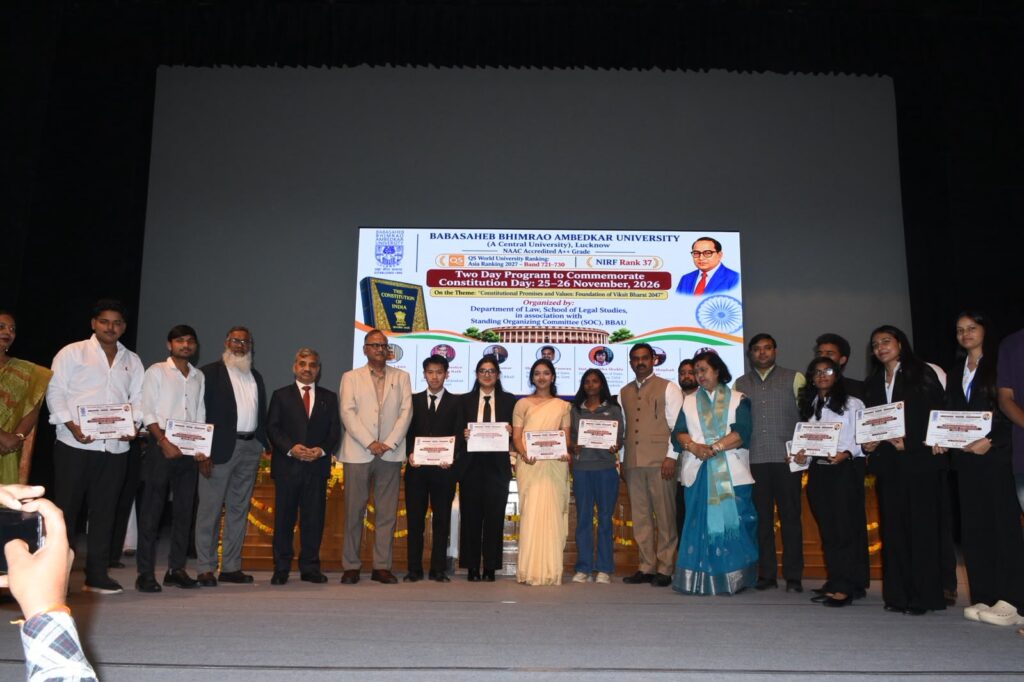
Lucknow: Babasaheb Bhimrao Ambedkar University (BBAU), Lucknow, inaugurated a two-day programme on November 25, 2026, on the occasion of Constitution Day, on the theme ‘Constitutional Commitments and Values: The Foundation of the Vision of Viksit Bharat @2047’. The programme was organised by the Department of Law. The Chief Guest was Shri Kamlesh Paswan, Minister of State for Rural Development, Government of India, while the Guest of Honour was Smt. Pratibha Shukla, Minister of State for Women Welfare, Child Development and Nutrition, Government of Uttar Pradesh. The dignitaries present on the dais included the Vice Chancellor of the University, Prof. Raj Kumar Mittal, who presided over the programme, Justice (Retd.) Shri Ranganath Pandey, former Judge of the Allahabad High Court, Prof. Shefali Yadav, Dean, Faculty of Law, Dr. Shakuntala Misra National Rehabilitation University, Prof. Sudarshan Verma, Programme Coordinator and Head, Department of Law, BBAU and Prof. Anees Ahmad. The programme commenced with the lighting of the ceremonial lamp and floral tributes to the statue of Babasaheb Dr. B. R. Ambedkar. This was followed by the University Kulgeet. The organising committee welcomed the dignitaries on the dais by presenting bouquets. At the outset, Programme Coordinator Prof. Sudarshan Verma welcomed all the guests and participants and briefed them about the objectives and outline of the programme. Subsequently, Dr. Khushnuma Bano presented the programme report.
In his address, Chief Guest Shri Kamlesh Paswan, Minister of State, Government of India, emphasised that understanding the historical background of the making of the Indian Constitution, the struggles of the freedom movement and the contributions of the Constitution makers is essential for every citizen, particularly the youth and students. He stated that before the drafting of the Constitution, Dr. B. R. Ambedkar had undertaken an in-depth study of the constitutions of various countries and played a significant role in the making of the Indian Constitution through his knowledge and experience. Highlighting Babasaheb’s social struggles, thoughts and contributions, Shri Paswan emphasised that the younger generation should study the historical facts and circumstances associated with his life. He urged students not to restrict themselves to textbooks but also to develop a deeper understanding of the country’s history, freedom struggle and the process of constitution-making, thereby fostering awareness and respect for constitutional values.
Addressing the gathering, University Vice Chancellor Prof. Raj Kumar Mittal stated that realising the vision of Viksit Bharat requires not only economic, social and technological development but also the adoption of constitutional values. He observed that the Preamble to the Indian Constitution, beginning with the words ‘We, the People of India’, envisages India as a Sovereign, Socialist, Secular and Democratic Republic, with the objective of securing justice, liberty, equality and fraternity for every citizen. Prof. Mittal explained that alongside economic development, the Constitution also emphasises the equitable distribution of resources, reduction of economic inequalities and promotion of small-scale and cottage industries. In this regard, the Directive Principles of State Policy play a significant role. He particularly emphasised that building a developed India requires the development of the country’s human capital, providing opportunities for every individual to realise their talent and potential, and ensuring equality and freedom from exploitation through Fundamental Rights.
Sharing her views, Smt. Pratibha Shukla, Minister of State, Government of Uttar Pradesh, stated that the rights guaranteed by the Indian Constitution provide a new direction to the country’s development. She emphasised that the active participation of every citizen is essential to translate constitutional values into action. She stressed the need to rise above caste, class and other forms of discrimination and strengthen mutual harmony, compassion and human relationships in society. The Minister further stated that trust and human sensitivity among lawyers, judges and ordinary citizens are essential for ensuring fair judicial decisions and adherence to constitutional principles. Encouraging the students, she urged them to remain dedicated to their studies and strive not only to become good lawyers but also educated and responsible citizens with strong moral values.
Justice (Retd.) Shri Ranganath Pandey, former Judge of the Allahabad High Court, stated that liberty, the rule of law, transparency and accountability are essential for establishing a healthy democracy. He observed that a strong democratic system cannot be envisioned unless transparency and accountability are ensured within democratic institutions. He noted that India is continuously progressing and moving rapidly towards becoming a developed nation by 2047. He also emphasised the importance of evaluating the country’s shortcomings and challenges alongside its achievements. Expressing his views on the independence of the judiciary, Justice Pandey stated that neither Parliament nor the Supreme Court is supreme; rather, the Constitution of India is supreme. Concluding his address, he emphasised that the true success of democracy depends on adopting ethical values along with constitutional principles.
Prof. Shefali Yadav, Dean, Faculty of Law, Dr. Shakuntala Misra National Rehabilitation University, highlighted the historical significance of November 26 in the establishment of Indian democracy and constitutional values. She stated that Babasaheb believed that the democratic framework enshrined in the Constitution should bring about revolutionary changes in the social and economic lives of people. She emphasised that achieving the vision of Viksit Bharat by 2047 requires inclusive development, which entails bringing all sections of society, including the poor, youth, women and farmers, into the mainstream of development. She further highlighted that alongside the aspiration of becoming a 35–40 trillion-dollar economy under the Viksit Bharat vision, it is equally important to maintain a balance between economic efficiency and equality. She observed that the true purpose of development can only be fulfilled when its benefits reach even the most deprived and marginalised sections of society. Therefore, ensuring social equality and inclusiveness alongside economic efficiency should form the foundation of a developed India.
Prof. Sudarshan Verma, Programme Coordinator and Head, Department of Law, BBAU, highlighted the significance of Fundamental Rights, the Right to Constitutional Remedies under Article 32, the Directive Principles of State Policy and Fundamental Duties enshrined in the Indian Constitution. She stated that the mere existence of rights is not sufficient; an effective mechanism for their protection and judicial remedies in cases of violation is equally important. Referring to the thoughts of Dr. B. R. Ambedkar, she described rights and duties as complementary to each other and emphasised that maintaining a balance between the two is essential for the effective functioning of the constitutional framework.
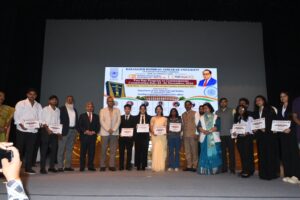
On this occasion, Everyone was informed about the Vidhik Sahayta Bandhu and Upbhokta Saksharta Culb. Apart from this the dignitaries felicitated the winners of the Poster Making, Slogan Writing and Quiz Competitions by presenting them with prizes and certificates. In the Quiz Competition, Himanshu Pandey secured first position, Muskan Kumari secured second position, Aditya Kushwaha secured third position, while Pradyumna Das received the consolation prize. In the Slogan Writing Competition, Asmita Bharti secured first position, Prachi Gautam secured second position, Vaibhav Anand secured third position, and Pallavi Bhardwaj received the consolation prize. In the Poster Making Competition, Prachi Gautam secured first position, Aishani Dutta secured second position, Dishita Yugal secured third position, while Ringu Tabil received the consolation prize.
At the end of the programme, the dignitaries were presented with mementoes by the organising committee as a token of gratitude. Prof. Anees Ahmad proposed the vote of thanks.
Faculty Deans, Heads of Departments, faculty members, non-teaching staff, research scholars and students from various departments and faculties of the University were present throughout the programme.










 https://www.youtube.com/watch?si=RtToJsBhYBatUrym&v=mOuYNSdhjHA&feature=youtu.be