
National Seminar on ‘Jain Knowledge Tradition: Language Development and Promotion’ Organised at BBAU
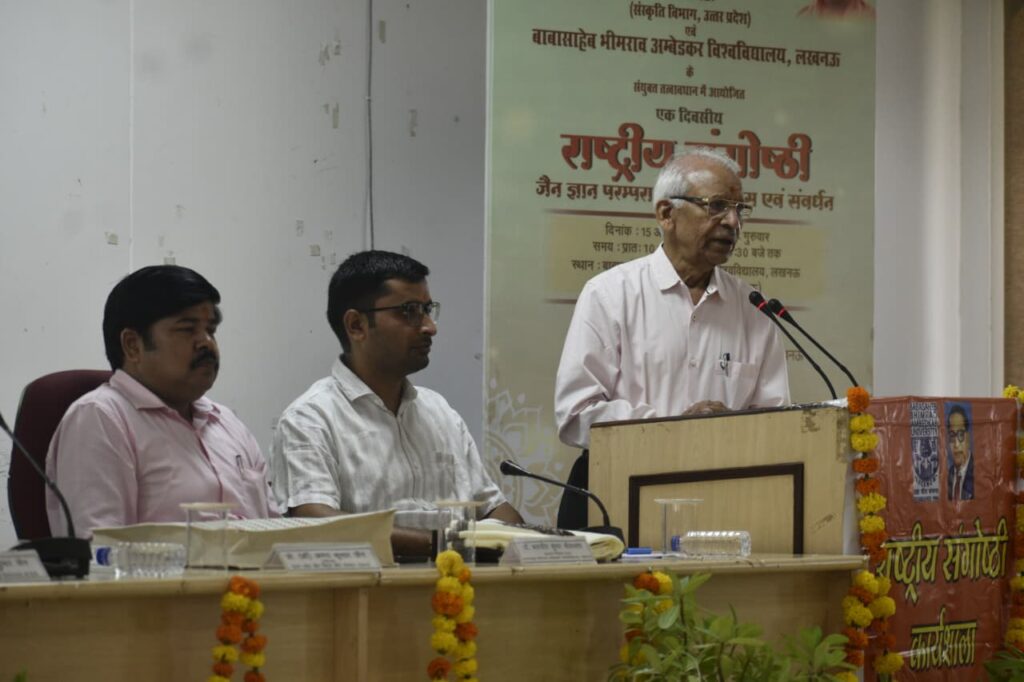
Lucknow: Babasaheb Bhimrao Ambedkar University (BBAU), in collaboration with the Uttar Pradesh Jain Vidya Shodh Sansthan, Lucknow, organised a one-day national seminar on ‘Jain Knowledge Tradition: Language Development and Promotion’ on October 15. The programme was presided over by the Vice-Chancellor of the University, Prof. Raj Kumar Mittal. Prof. Vijay Kumar Jain from the Bhogilal Leherchand Institute of Indology, New Delhi, attended the programme as the Chief Guest. The other dignitaries present on the dais included Prof. Anekant Kumar Jain from Lal Bahadur Shastri National Sanskrit University, New Delhi, as the keynote speaker, Prof. Abhay Kumar Jain, Vice-Chairperson of the Uttar Pradesh Jain Vidya Shodh Sansthan, Prof. Harishankar Mishra from the University of Lucknow and Dr. Baljeet Kumar Srivastava, the programme coordinator. The programme commenced with the lighting of the ceremonial lamp and the offering of floral tributes to the portrait of Babasaheb Dr. B.R. Ambedkar. This was followed by the rendition of the University Kulgeet. The organising committee felicitated the dignitaries on the dais by presenting them with shawls and mementoes. Dr. Baljeet Kumar Srivastava, the programme coordinator, welcomed all the attendees. Subsequently, Prof. Abhay Kumar Jain briefed the audience about the objectives and outline of the programme.
In his address, Vice-Chancellor Prof. Raj Kumar Mittal discussed the major principles of Jainism in detail, with particular emphasis on the principle of Aparigraha, or non-possessiveness. He observed that despite the abundance of resources available today, people are increasingly moving towards uncontrolled consumption, which may have negative long-term consequences. This affects several areas, including environmental protection, social balance and individual well-being. He stated that the principle of Aparigraha in Jainism inspires people to use resources according to their needs, avoid unnecessary accumulation and understand their responsibility towards nature. He added that these principles have become even more relevant in the present times, as balanced lifestyles and responsible behaviour are essential for moving towards sustainable development. Prof. Mittal also elaborated on the important principles of Jain philosophy, including Samyak Drishti (right perception), Samyak Jnana (right knowledge) and Samyak Charitra (right conduct). He emphasised that the right perspective, positive thinking and ethical conduct play a significant role in shaping an individual’s personality and establishing better values in society. He stated that Jain philosophy should not be viewed merely as a religious ideology, but also as a philosophy that provides the right direction for life. He further assured that Babasaheb Bhimrao Ambedkar University and the Uttar Pradesh Jain Vidya Shodh Sansthan would work together in this direction in the future, providing students with opportunities to explore and understand various aspects of Jain philosophy and learn about their practical significance.
Prof. Vijay Kumar Jain from the Bhogilal Leherchand Institute of Indology, New Delhi, discussed the principles of Jainism and observed that Jain philosophy is closely associated with social justice, equality and the acceptance of truth. He stated that Jainism inspires individuals to understand the truth, adopt the right perspective and respect the opinions of others. He explained that Ahimsa, or non-violence, is the fundamental principle of Jainism. It is not limited to abstaining from physical violence but also conveys the message of not causing harm to anyone through one’s thoughts, words or actions. Jain philosophy does not advocate destruction or causing harm; rather, it emphasises establishing peace in society through love, compassion, tolerance and mutual harmony. He added that the principles of Jainism have become even more relevant today, as society faces challenges such as differences of opinion, intolerance and uncontrolled consumption. The Jain principle of Anekantavada teaches us that every subject must be understood from different perspectives. According to him, the principles of Jain philosophy not only promote self-restraint and morality in individual life but also contribute significantly to social equality, environmental protection and peaceful coexistence. He emphasised that adopting these values can help build a sensitive, just and inclusive society.
Prof. Anekant Kumar Jain from Lal Bahadur Shastri National Sanskrit University, New Delhi, stated in his address that while society continues to progress and develop, it is equally important to preserve and promote the Jain tradition. He discussed various aspects of the language associated with the Jain community, its development and its relevance in society. He observed that the Jain tradition has made a significant contribution to India’s social, cultural and intellectual development. Through language and literature, it has played an important role in conveying knowledge, ethical values and humanistic ideas to society. He further stated that language and speech hold special significance in human life. Language is not merely a means of communication but also an important medium for transmitting ideas, values and traditions to future generations. He emphasised that the preservation and development of languages and literature associated with the Jain tradition are essential not only for safeguarding this rich heritage but also for promoting non-violence, truth, tolerance and human values in society.
Prof. Abhay Kumar Jain highlighted the work undertaken by the Uttar Pradesh Jain Vidya Shodh Sansthan and its role in preserving and promoting Jain religion, literature and culture. He explained that the institute works on various aspects of the Jain tradition through research, academic studies and literary activities. Efforts are also being made to familiarise society with the principles of Jainism, its historical heritage and cultural values, while introducing the younger generation to this rich tradition. During the programme, individuals who have made notable contributions to the preservation and promotion of Jain philosophy, literature and culture were felicitated.
Deans, Heads of Departments, faculty members, non-teaching staff, research scholars and students from various faculties attended the programme.










 https://www.youtube.com/watch?si=RtToJsBhYBatUrym&v=mOuYNSdhjHA&feature=youtu.be